

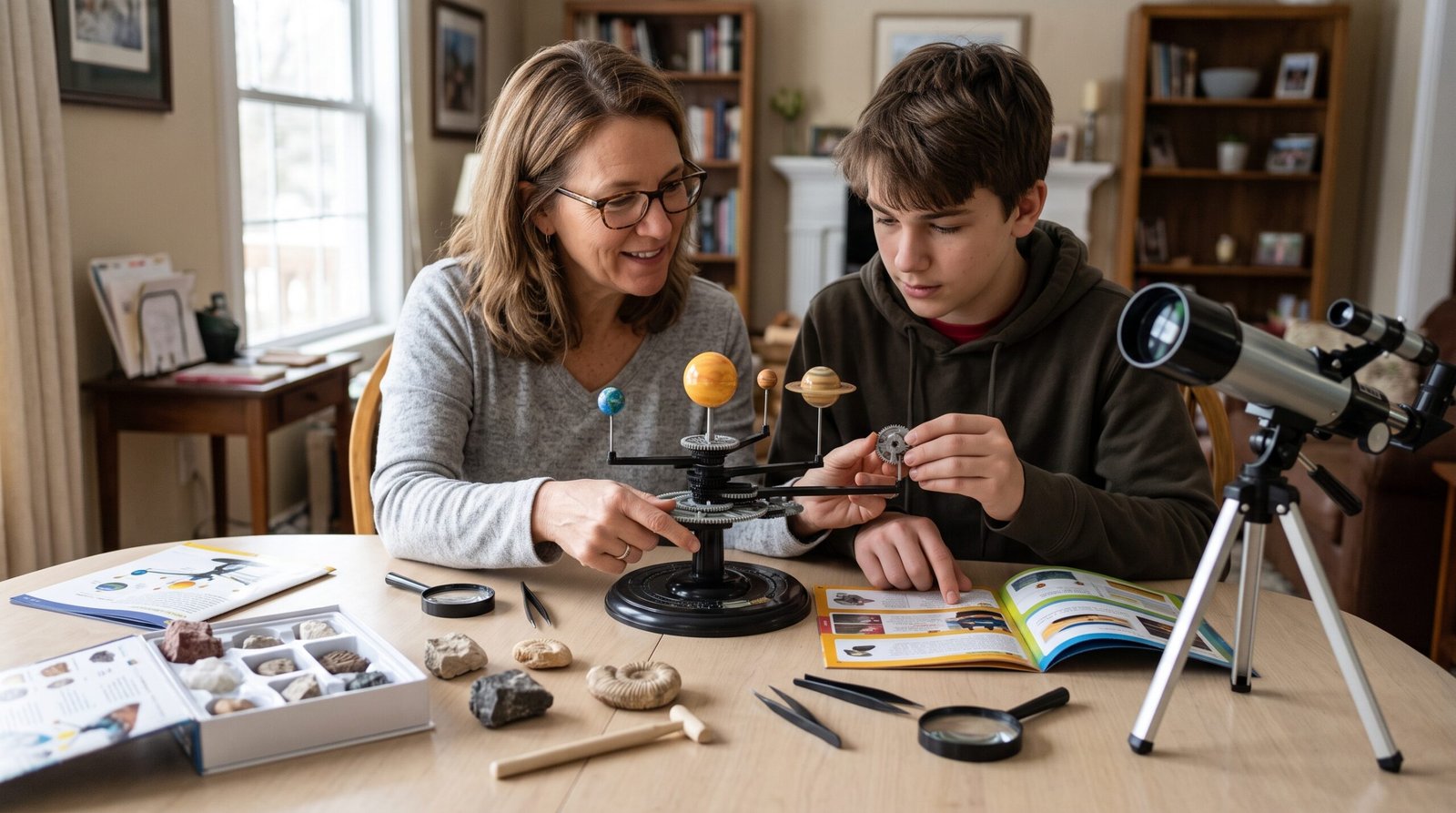
Finding the perfect home space science kit for teens can often feel like trying to navigate through a dense asteroid field without a map. As a mom to a 15-year-old boy and an educator with 30 years of teaching experience, I have seen my fair share of STEM toys that promise the moon but deliver little more than flimsy plastic and frustration. Teenagers are at a critical age where they crave authenticity; they want real tools, challenging mechanics, and genuine scientific discovery, not childish models. If you want to pull them away from their smartphones and video games, you need a home space science kit for teens that offers hands-on engagement and a touch of awe.
Based on the products we’ve recently explored and diving deep into real Amazon customer reviews, I have compiled a detailed guide to help you make the right choice. Whether your high schooler is an aspiring engineer who loves gears, or a budding astronomer wanting to map the lunar craters, choosing a high-quality home space science kit for teens is an investment in their critical thinking skills. Today, we are going to review three of the best options available on Amazon US, dissecting their pros, cons, and real-world performance to help you find the absolute perfect match for your family.
Why Investing in a Home Space Science kit for teens Matters
You might be wondering if a dedicated home space science kit for teens is truly necessary when they already take science classes in high school. The reality of modern education is that classroom time is strictly scheduled, leaving very little room for open-ended, curiosity-driven exploration. A well-designed home space science kit for teens gives your child the freedom to tinker, fail, adjust, and succeed at their own pace, entirely free from the pressure of a grading rubric.
When my 15-year-old son unpacks a new mechanical model or sets up a telescope in the backyard, I see a level of focus that standard homework rarely inspires. These tools bridge the gap between abstract textbook theories—like planetary gear ratios or orbital mechanics—and tangible reality. Furthermore, analyzing Amazon reviews reveals a common thread among parents: a challenging home space science kit for teens fosters patience and problem-solving. When a gear doesn’t turn smoothly or an eyepiece is out of focus, teens must diagnose and fix the issue, which is the very essence of real-world scientific inquiry.
Top Mechanical Pick: Thames & Kosmos Orbiting Solar System STEM Kit
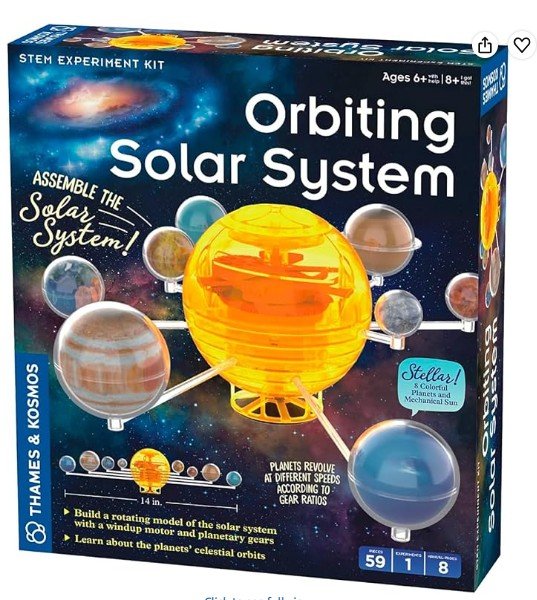
If your teenager is someone who loves to build and figure out how things work from the inside out, the Thames & Kosmos Orbiting Solar System is an absolutely stellar home space science kit for teens. Instead of just looking at the stars, this kit allows them to build a working, mechanical orrery.
The beauty of this particular home space science kit for teens is that it requires zero batteries. It relies entirely on a hand-wound wind-up motor, teaching teens the physical principles of potential and kinetic energy. My son spent a couple of hours snapping the 59 pieces together, completely absorbed in how the planetary gears dictate the speed of each orbiting planet. Reviewing Amazon customer feedback, many parents and grandparents praise the clear instructions and the clever inclusion of a slot for a hypothetical “Planet Nine.” However, some reviews mention that the wind-up motor only runs for a short time before needing a rewind. Overall, this home space science kit for teens is a fantastic, hands-on engineering project that doubles as a beautiful desk display.
Check out the Thames & Kosmos Orbiting Solar System on Amazon
Pros:
- Eco-friendly and reliable because it requires absolutely no batteries.
- Teaches complex mechanical engineering and planetary gear ratios.
- Highly engaging build process that keeps teens focused.
- Includes a beautiful, full-color educational manual.
Cons:
- The mechanical spring motor only runs for a brief period before needing to be rewound.
- The planetary sizes and distances are not exactly to scale (which is mechanically necessary, but worth noting).
Best for Backyard Stargazing: Celestron PowerSeeker 127EQ Telescope

Transitioning from mechanical models to actual celestial observation, the Celestron PowerSeeker 127EQ Telescope is arguably the most popular observational home space science kit for teens on the market. With a massive 127mm (5-inch) aperture, this telescope gathers a tremendous amount of light, allowing teenagers to clearly see the rings of Saturn, the moons of Jupiter, and breathtaking details of lunar craters.
As a home space science kit for teens, it provides a serious leap from toy binoculars to genuine optical equipment. The German Equatorial (EQ) mount is a standout feature, though it comes with a steep learning curve. According to numerous Amazon reviews, beginners sometimes struggle with balancing the counterweights and dialing in the tracking knobs. However, once mastered, this mount allows teens to seamlessly track objects as the Earth rotates. Another common theme in the customer reviews is the quality of the included accessories; while the 20mm eyepiece is fantastic, the 4mm eyepiece and 3x Barlow lens tend to push the magnification too far, resulting in blurry images. Despite this, for the price point, this home space science kit for teens offers unbeatable light-gathering power and a true taste of amateur astronomy.
Explore the Celestron PowerSeeker 127EQ Telescope on Amazon
Pros:
- Large 5-inch aperture delivers bright, crisp views of deep-sky objects and planets.
- The EQ mount teaches real astronomical tracking and celestial coordinates.
- Incredible value for the size of the primary mirror.
- Short optical tube makes it easier for teens to carry into the backyard.
Cons:
- The included high-magnification accessories (4mm lens and Barlow) offer poor image quality.
- Requires regular collimation (mirror alignment), which can be frustrating for beginners.
- The aluminum tripod can be wobbly in the wind if fully extended.
Best Value Exploration: National Geographic Mega Earth and Space Science Kit
For parents who want to cover multiple scientific bases without spending a fortune, the National Geographic Mega kit serves as an incredibly versatile home space science kit for teens. While it leans heavily into earth sciences, it provides a foundational understanding of the geological materials that make up terrestrial planets in our solar system.
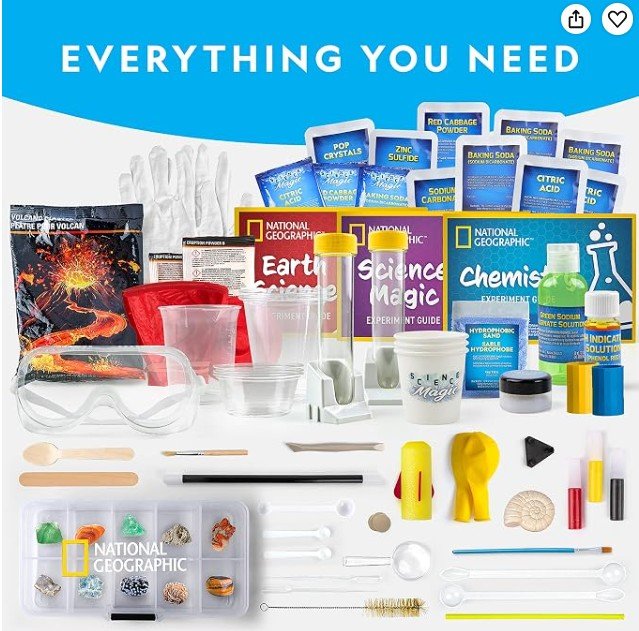
This home space science kit for teens includes over 15 distinct experiments, ranging from growing crystals to excavating genuine meteorites and fossils. My 15-year-old was surprisingly thrilled to chip away at the dig brick to reveal a real piece of a meteorite. Digging into Amazon’s after-sales reviews, parents consistently highlight the sheer volume of activities included in the box. Reviewers love the high-quality, full-color learning guide that National Geographic is famous for. If there is a downside noted in the reviews, it is that the plaster excavation projects can be incredibly messy, so you will definitely want to set this home space science kit for teens up outdoors or on a well-protected table.
Grab the National Geographic Mega Earth Science Kit on Amazon
Pros:
- Offers massive variety with over 15 different hands-on experiments.
- Includes a genuine meteorite specimen, which is incredibly cool for space lovers.
- The included educational booklets are beautifully illustrated and deeply informative.
- Outstanding price-to-value ratio.
Cons:
- The excavation activities create a significant amount of plaster dust.
- Some experiments, like crystal growing, require several days of waiting for results.
Key Features to Look For in a Home Space Science kit for teens
Before you make a final decision, there are a few critical factors to consider when evaluating a home space science kit for teens. First, consider the complexity. With 30 years of teaching experience, I cannot stress enough that teenagers will quickly abandon a kit if it feels like a child’s toy. Look for a home space science kit for teens that requires genuine assembly, calibration, or problem-solving.
Second, read the after-sales reviews carefully regarding durability. A good home space science kit for teens should feature sturdy materials—like the metal frame of the Celestron telescope or the thick, durable plastic gears of the Thames & Kosmos orrery. Flimsy parts lead to broken experiments and disappointed teens. Finally, always check the educational literature included. A premium home space science kit for teens won’t just tell a teenager how to do an experiment; it will explain the physics and chemistry of why it works.
Final Thoughts on Choosing a Home Space Science kit for teens
Fostering a love for the cosmos during the teenage years is one of the most rewarding gifts you can give as a parent. Selecting the right home space science kit for teens is all about matching the tool to your child’s specific interests. If they love engineering and building, the Thames & Kosmos Orbiting Solar System will keep their hands busy and their minds engaged. If they are desperate to look at the actual stars, the Celestron PowerSeeker 127EQ provides a massive optical window to the universe. And if they love geology and hands-on digs, the National Geographic kit offers incredible variety.
Whatever you choose, bringing a high-quality home space science kit for teens into your household is a brilliant way to encourage unplugged, critical thinking. Watching my son successfully align his telescope mirrors or assemble a planetary gear system brings me immense joy. Take the time to evaluate what will spark that same joy and curiosity in your teenager, and you will be setting them up for a lifetime of scientific wonder.
This post contains affiliate links, meaning I may earn a small commission if you make a purchase through them at no extra cost to you.